

If you are looking to try a rehearsal sweet before the next big celebration, this is it. No matter the season or reason, I find myself making this. Tried, tested, and loved, it never lets me down. You really can’t go wrong with a batch to share with family and friends.
It comes together with just a few ingredients, requires no elaborate tools, besides the usual suspects: a penda press, an empty thread spool, or an old-fashioned glass with a fancy bottom.
I grew up watching sweets take shape in heavy-bottomed pans. Sometimes with no measurements at all. Recipes were passed down not on paper, but in gestures. A bowl of this, a karcha full of that, and a whole lot of instinct.
This recipe is adapted from a handwritten note that has travelled across generations, and calls for fresh mawa or mava/Mavo, but I often use store-bought Nanak brand for ease and consistency.
I’ll admit it. I cannot for the life of me recreate the homemade khoya my grandmothers and mum used to make. That deep caramelish hue, the mild, sweet and buttery aroma and, that stiff texture that melted just so with heat. It’s nearly impossible to replicate. But Nanak’s version is reliable and firm, which makes it ideal for penda that hold their shape and bite.
The process is simple. Mawa is gently warmed with sugar, cardamom, and a touch of ghee until it thickens into a smooth, unified mass. Then, just enough saffron-infused milk is stirred in to bind the dough and lend its golden hue.
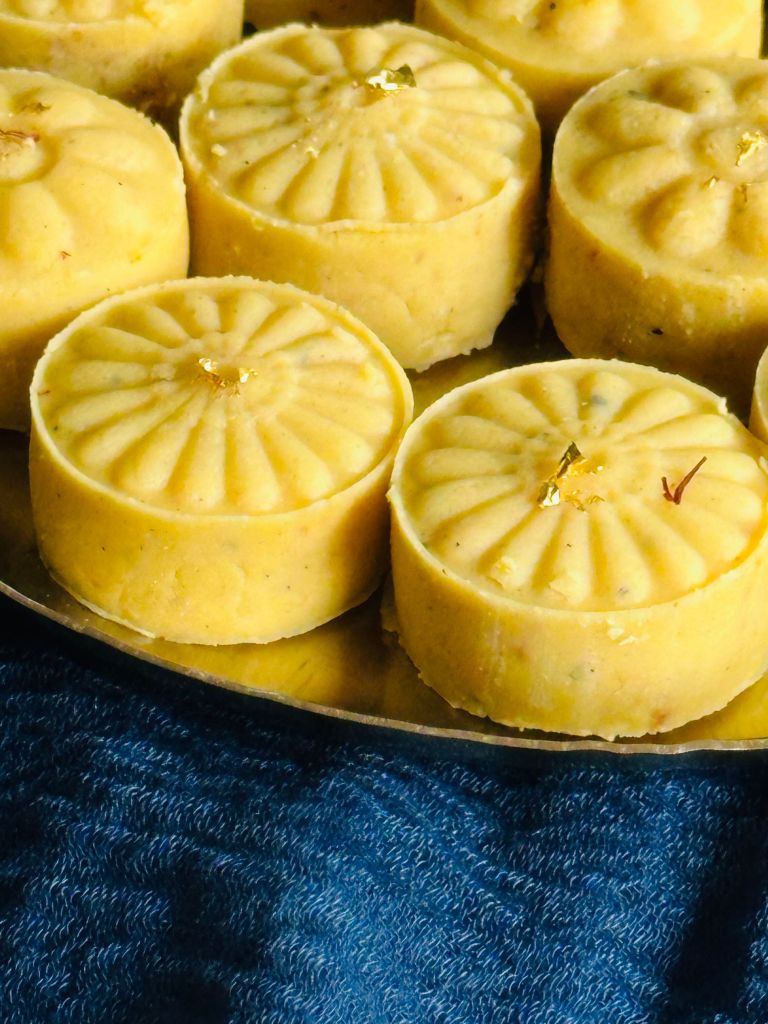
The best part comes next. Shaping the penda by hand while still warm. Although I confess, I now use a penda press to get a cleaner finish and a more uniform look.

If done right, these penda are smooth, lightly golden, and delicately aromatic. Not too soft, not dry. Just enough.
I usually top each one with a sliver of almond or a sprinkle of crushed pistachio. Simple, familiar, and enough. It’s not really about decoration. It’s about texture, habit, and doing things the way I saw them done. At home, with care, with no shortcuts in spirit.
Sometimes, if I’m feeling a little festive or showing off, I’ll press on a bit of edible gold varak. You don’t need it, but it does catch the light beautifully. A little nod to celebration without forgetting where the sweet began.
Watch me make it here:
Kesar Mawa na Penda
Yields: approx. 20 pieces
Time: ~25 minutes
Ingredients
- 1 (12 oz) pack Nanak Khoa (or similar), crumbled
- ½ tablespoon milk, slightly warmed
- A pinch of saffron pistils
- 1½ teaspoons ghee or butter
- ¼ cup sugar (adjust to taste)
- ¼ teaspoon nutmeg powder
- ½ teaspoon cardamom powder
- Almond slivers or crushed pistachios for garnish
- Edible gold varak for garnish (optional)
Instructions
1. Bloom the saffron in a small bowl, add saffron threads to the warm milk. Set aside to infuse.
2. Warm the Khoya mixture in a thick-bottomed or nonstick pan, crumble in the khoya and set over medium-low heat. Stir in the ghee or butter, sugar, and cardamom.
Tip: Keep the heat gentle. You should not hear loud sizzling.
3. Cook until smooth, stir continuously. As the khoya melts and sugar dissolves, the mixture will begin to thicken and come together into a soft mass.
4. Add the infused saffron milk a little at a time.
Only use what is needed to bring the mixture together. Too much will prevent the penda from setting.
Continue stirring until the mixture is glossy and pulls away from the sides of the pan like soft dough.
5. Remove from heat and allow to cool until warm and pliable.
Grease your hands with a bit of ghee. Roll into smooth discs or press with a penda mold.
6. Top with slivered almonds, crushed pistachios, or a touch of edible varak if using. Let the penda cool completely to firm up.
Store in an airtight container for 4 to 5 days. Refrigerate if keeping longer.
Notes from my Kitchen:
Store bought khoya tends to be dry; the recipe accounts for this with warm milk.
A small amount of ghee on your hands will help shape smooth, crack-free penda.
Use a heavy-bottomed or nonstick pan to prevent sticking.
Penda firms up more as it cools, so do not overcook
If you try this recipe, let me know how it goes. Tag me or share a photo I am always thrilled to see these little traditions come alive in your kitchens

 Nadia's Meza recipes
Leave a comment