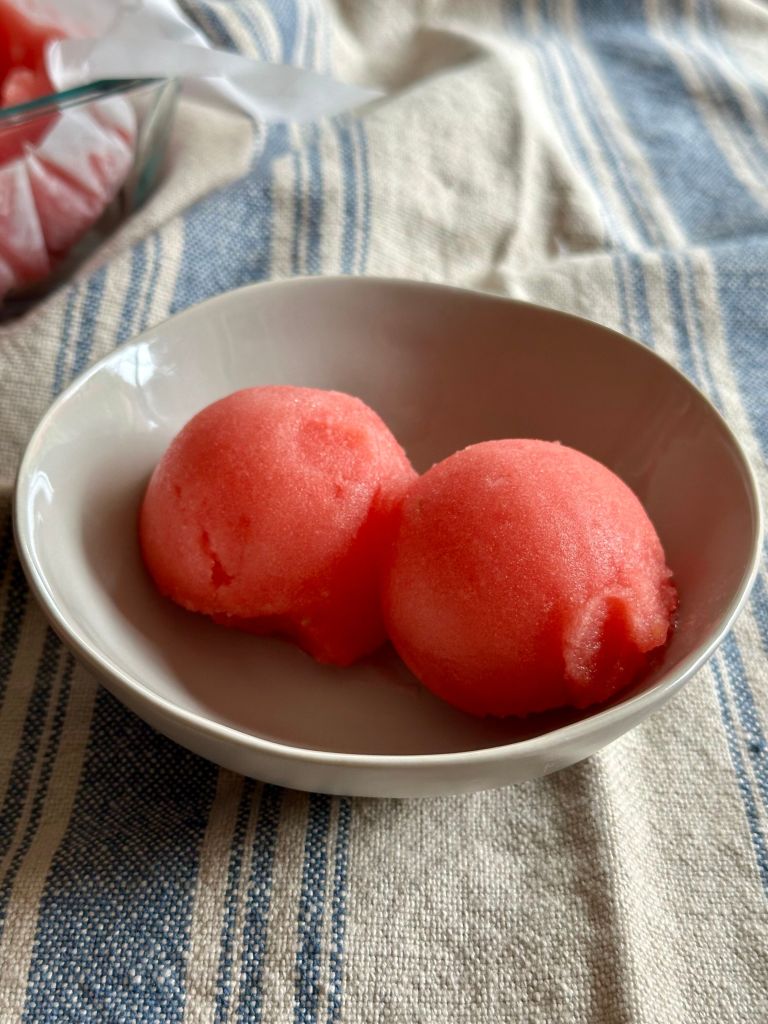
Like all of my favorite foods, watermelon is best eaten in properly large quantities while in season. Around here, the summer heat arrives early, while it is still snowing somewhere up North, and overstays its welcome. And let’s not forget those surprise scorcher days in April and November (because that’s DMV weather for you). These days call for, refreshing treats that require very little effort, no faff, no hob, and zero cooking.
Though we often think of sorbet as an Italian treat, sorbetto, smooth and fruity, it actually has deeper roots. The idea of freezing fruit juice or syrup with snow dates back to ancient Persia and the Arab world, where it was known as sharbat. These were not frozen, but were often served over ice or snow gathered from the mountains or ice houses (yakhchāl). As the idea of iced refreshment spread through the Mediterranean, it eventually evolved into the frozen, spoonable desserts of Renaissance Italy, and later, the elegant sorbets of French cuisine.
This blushy coral watermelon lime sorbet is quick to make, a fun and easy treat that even kids can help with, and frankly better than anything store-bought.
It comes together in a food processor-no cooking, no straining, no churning required. Just cut, freeze, blitz, and freeze. It’s plenty good as is, but if you want to gild the lily, add a drizzle of fig and balsamic glaze (yes the same one you drizzle on your salads, I like the Giuseppe Giusti brand) and a few mint leaves, or just toss the mint straight in while blending for a blast of freshness in every spoonful.

This isn’t just a sweet treat, it’s a healthy one too. Watermelon is naturally low in sugar (yes, really! half that of apples) but tastes sweeter thanks to its high water content. It is also packed with vitamins A and C, potassium, beta-carotene, and lycopene, the antioxidant linked to eye and heart health. In traditional remedies, watermelon is believed to support the bladder, soothe digestion, relieve heat-related fatigue, and even chase away the blues.
And unlike traditional ice creams, sorbet skips the dairy and sweeteners, making it vegan, paleo, gluten-free, and a dream for anyone avoiding processed sugar (although I recommend using a simple syrup to sweeten it if your watermelon is not sweet).
A dessert that’s hydrating, healing, and easy to make? Yes, please. I hope this sorbet becomes a go-to in your warm weather kitchen.
Watermelon Lime Sorbet
Ingredients
- 5 cups cubed ripe watermelon (seedless or seeds removed)
- Juice of 1 lime
- 2–4 tablespoons simple syrup (optional, to taste)
- 6–8 fresh mint leaves (optional, for blending or garnish)
- Fig and balsamic glaze (optional, for drizzling)
Instructions
- Start by cutting your watermelon into bite-sized cubes and lay them out in a single layer on a tray and transfer the tray into the freezer and let the watermelon freeze completely-overnight is ideal. (You can blend after a few hours, but for a true sorbet texture, make sure the cubes are fully frozen. Otherwise, you’ll end up with more of a slush than a scoopable sorbet.)
- Once frozen solid, add the watermelon cubes to a food processor or high-speed blender. Squeeze in some fresh lime juice, start with the juice of half a lime for every 2 to 3 cups of watermelon. You can always add more to brighten it up, so go slow and adjust to taste.
- Blend until smooth and sorbet-like, pausing to scrape down the sides if needed. If the texture is too thick or not blending well, a splash more lime juice or some simple syrup will help loosen things up.
- If your watermelon is not super sweet, stir in a little simple syrup, start with a tablespoon and adjust to your liking.
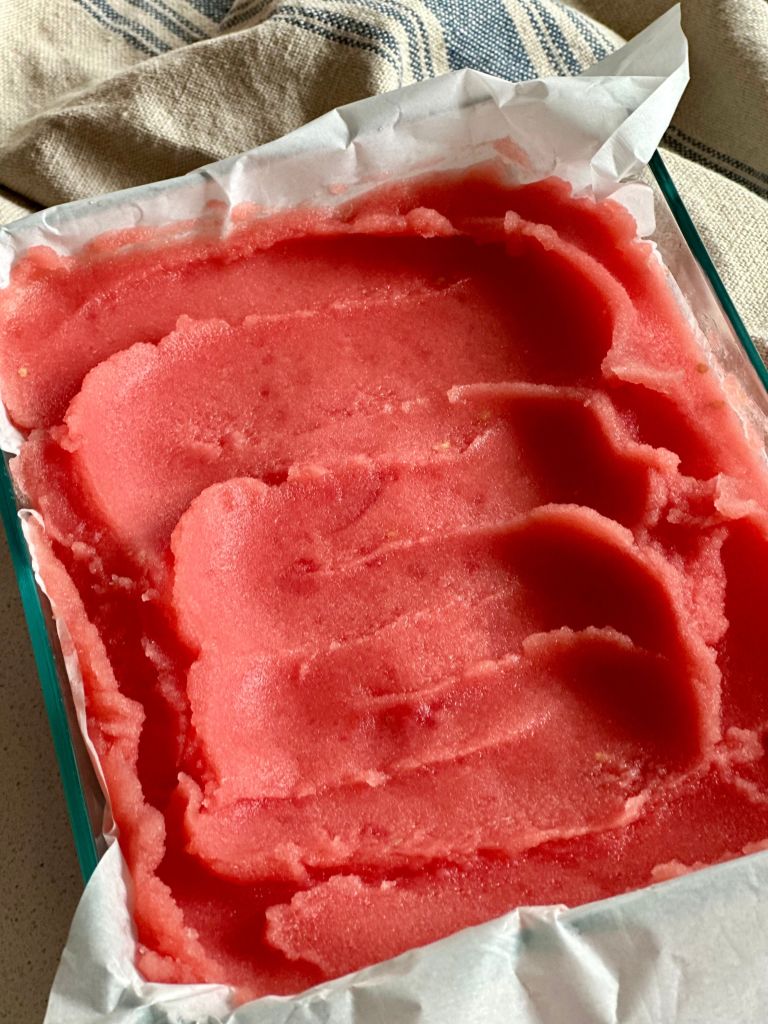
- Scoop and serve immediately for a soft-serve texture, or transfer to a freezer-safe container, preferably lined with parchment ( fold the flaps of the parchment over the sorbet to prevent icicles and burn, and freeze for another 1–2 hours if you prefer a firmer sorbet.
- To serve, let it sit on the counter for 5–10 minutes to soften slightly, then scoop into bowls and enjoy.
- Optional (but highly recommended): drizzle with fig and balsamic glaze, or garnish with fresh mint and lime to finish.
Watch how this no-fuss Watermelon Lime Sorbet comes together
Notes from my Kitchen:
Tips for Choosing a Ripe Watermelon
Check the stem end If it’s visible, the stem (or remnant) should be dry and brown, that’s proof it matured fully on the vine, rather than being picked early.
Look for webbing (“sugar spots”) These telltale brownish-gray, cobweb-like lines indicate bees have pollinated the melon thoroughly and sugar is seeping out, a sign of sweetness. The larger, more prominent webbing points to a sweeter fruit.
Find the field spot (yellow belly)
Turn the melon over and look for a creamy, buttery-yellow patch, it is the area resting on the ground. The larger and deeper yellow it is, the riper the melon. White spots mean under-ripe.
Check for dull, matte skin
A ripe watermelon has dark green, matte skin. Shiny rinds often indicate unripe fruit.
Feel the weight
A ripe watermelon should feel heavy for its size. Since melons are over 90% water, heft equals juiciness and sweetness.
Tap for a deep, hollow tone
A deep, drum-like sound often signals ripeness. A dull thump means either underripe or overripe. While subjective, since it never works for me, it’s a helpful hint.
Inspect shape and symmetry
Look for a uniformly shaped melon, one which is either oval or round, with smooth, unblemished rinds. Irregular bumps can mean uneven growth.
Have you made watermelon sorbet at home before?
Tell me how you serve it—or what twist you add to make it your own. Leave a comment below, share your photos, or tag me on Instagram @spicymemsahib. I would love to see what you blend up this summer.

 Nadia's Meza recipes
Leave a comment