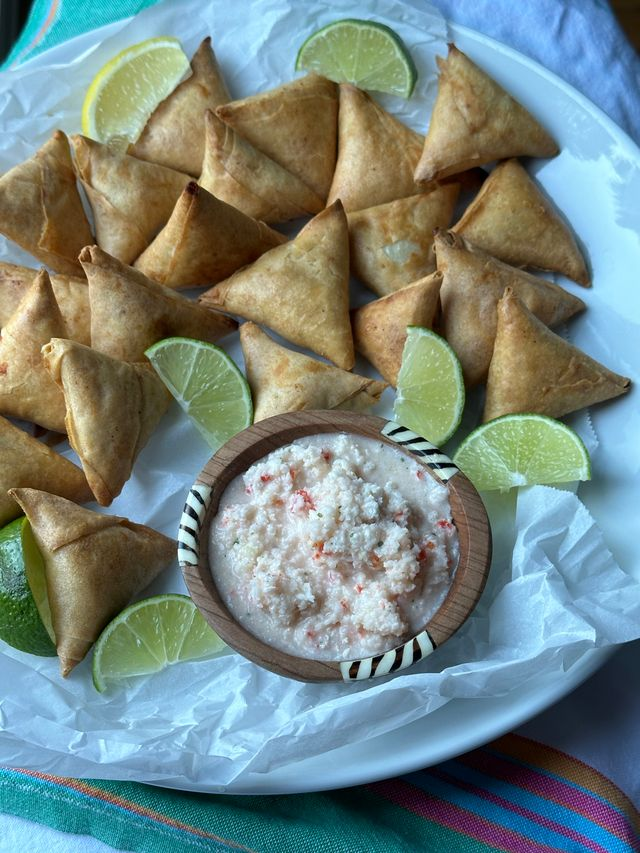
A little history on this glorious well traveled triangular snack~ Samosas are so identified with Indian cuisine that it comes as a surprise for many to learn Indians didn’t invent this iconic snack. In fact, samosas were introduced to India and parts of Africa by merchants from the Middle East.
Originally known as samsa, paying homage to the pyramids of Central Asia, likely that it might have come from Kazakhstan, Uzbekistan and Turkmenistan, where royal families of time bygone transported these as snacks for hunting and royal tea parties. The earliest records of recipes are found in 10th–13th-century Arab cookery books, indicating it to have originated in Persia around the 11th century AD, under the names sambuseh, sanbusak, sanbusaq, and sanbusaj, all deriving from the Persian word sanbosag.
Growing up in Tanzania, I would see street food vendors selling this flavor-packed delicacy, known locally as sambusas, but they were most often filled with beef. As Sunday treats we would get the lamb samosas sold at the little bar inside of the Elite Cinema. We would skip over with my Ayah to where my Dad and his friends were having drinks, and sit outside on the barazza with other friends, waiting for the one of the staff to bring out the brown paper bag dotted with oil containing four samosas and lime wedges, a couple of newspaper cones of roasted peanuts and ice cold Coke bottles. We would either climb onto the truck bed of a friends car or spread out our food over the barazza, emptying the peanuts into the Coke bottle and chugging it down between bites of samosas squeezed with lime.
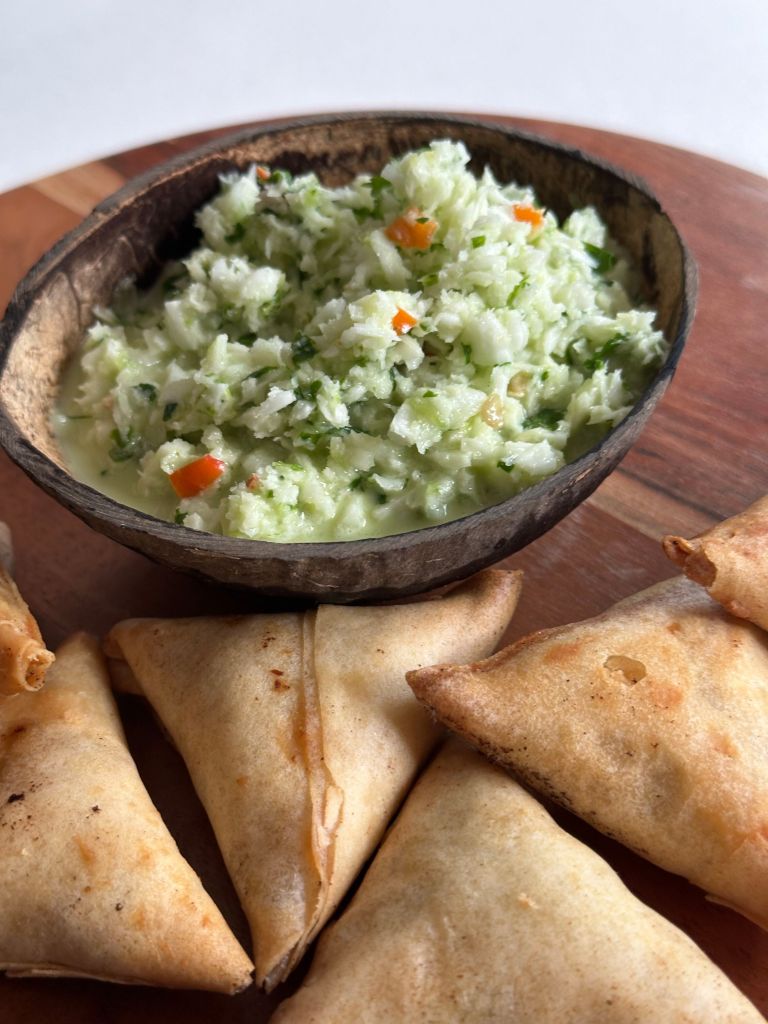
My Mum made them with minced lamb which was marinated the night before, I often asked her why, and she would say that it made the lamb more flavorful and removed the gamey smell, her were tiny and uniform in size, my MaaIL, on the other hand, made hers with minced beef, and I make them with minced chicken.
East African home cooks have varied takes on samosa fillings, but the homemade “pati” or wrapper is non-negotiable, its taste and texture is.
The mornings would start with Mum preparing dough. The clinking bangles pushed far up her forearms and as she kneaded, rolled circles, glued them together with oil, and rolled a larger one, then over a gentle flame cooking the pastry, flipping and peeling off delicate pastry sheets. Each sheet would be cut into a semi-circle, which would eventually be formed into a hollow triangle that would be stuffed with a veggie or meat mixture. Some she would cut into strips and deep fry for the kids to eat with ketchup.
Sometimes she would cut the circle into small strips to make mini cocktail samosas, the method I am using in the video is what Mum called “sari – samosa” because you sort of fold it like a sari! When you move away from home, I think most will agree that using store-bought spring roll wrappers is the key to unparalleled crispness.
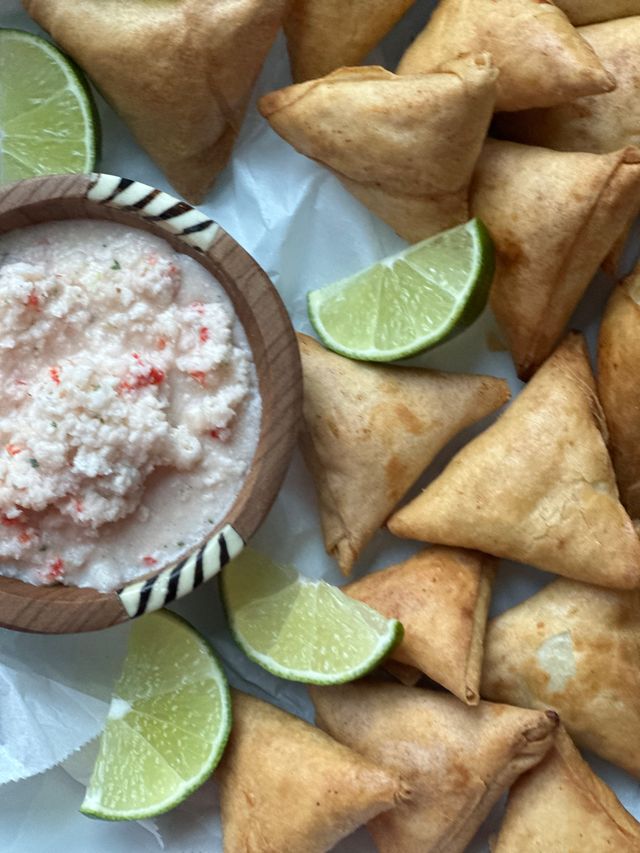
I usually spend a whole Saturday, meditatively filling close to 400 medium sized samosas, flash frying them to just crisp up the outer layer and freezing them in batches so they’re ready to be popped into the air fryer anytime we fancy a bite with our chai. Serve these with nariyal ni chatni (coconut chutney) and wedges of lime.
Watch me make them here!
Basic Kheema filling:
To make the mince meat filling:
- 2 lbs. (4 cups) lean ground Chicken/lamb/beef
- 1 tablespoon vegetable oil (optional my MaaIl used it)
- 1/4 cup water
- 1.5 teaspoon garlic paste
- 1 teaspoon ginger paste
- 1 teaspoon Thai green paste or more
- ½ teaspoon turmeric
- 1.5 teaspoon ground cumin and coriander powder (Dhana jeera)
- 1/2 teaspoon dry red chili powder (optional)
- 2 cups finely cut yellow/Spanish onions
- 1 cup finely cut green onion (cut in ½ lengthwise first)
- 1 teaspoon garam masala
- 2 teaspoon salt or to taste
- 3 tablespoons lemon juice
- ½ cup finely cut cilantro
- 3 green onions, finely sliced (optional)
- 2 finely cut jalapeño or Thai hot chilies (optional)
- 8 fresh mint leaves finely cut (optional)
Instructions:
- Heat a large skillet or wok on medium heat and add the ground meat with the 1/4 cup water. (My MaaIL used to heat a bit of oil and add the meat – I do it both ways)
- Stirring continuously and breaking up the mince, until finely crumbled.
- Add, ginger, garlic and chili pastes, salt, turmeric, cumin & coriander powder.
- Cook for 8-9 minutes, stirring at regular intervals, until all the juices are absorbed and the mixture is dry.
- Stir in the lime juice and the garam masala and red chilli powder (if using) and cook for a further minute.
- Leave the mixture to cool down before adding the onions, spring onions and cilantro (jalapeño pepper and mint if using), Mix well.
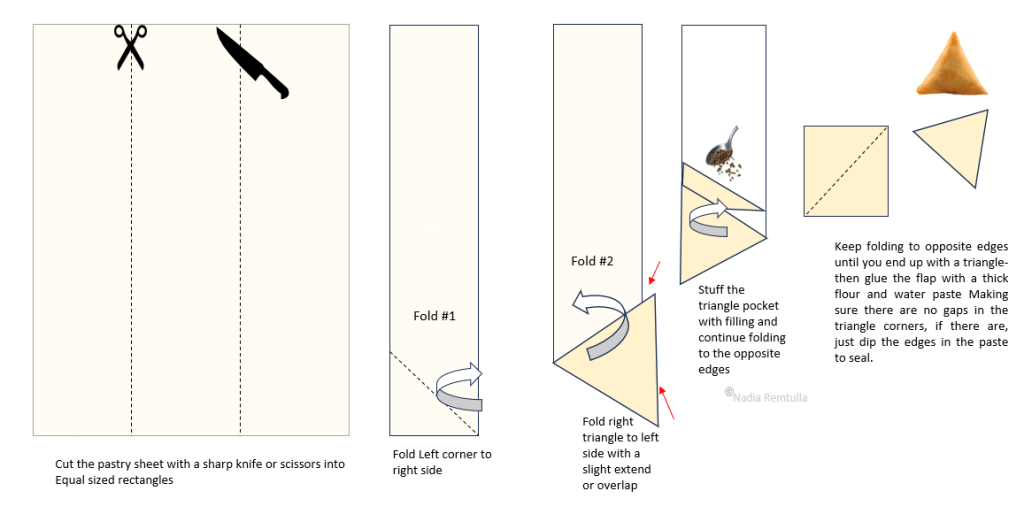
How to fold the samosas using Spring Roll Wrapper or Homemade wrappers ~ know as the“Sari Method”:
How to air fry samosas:
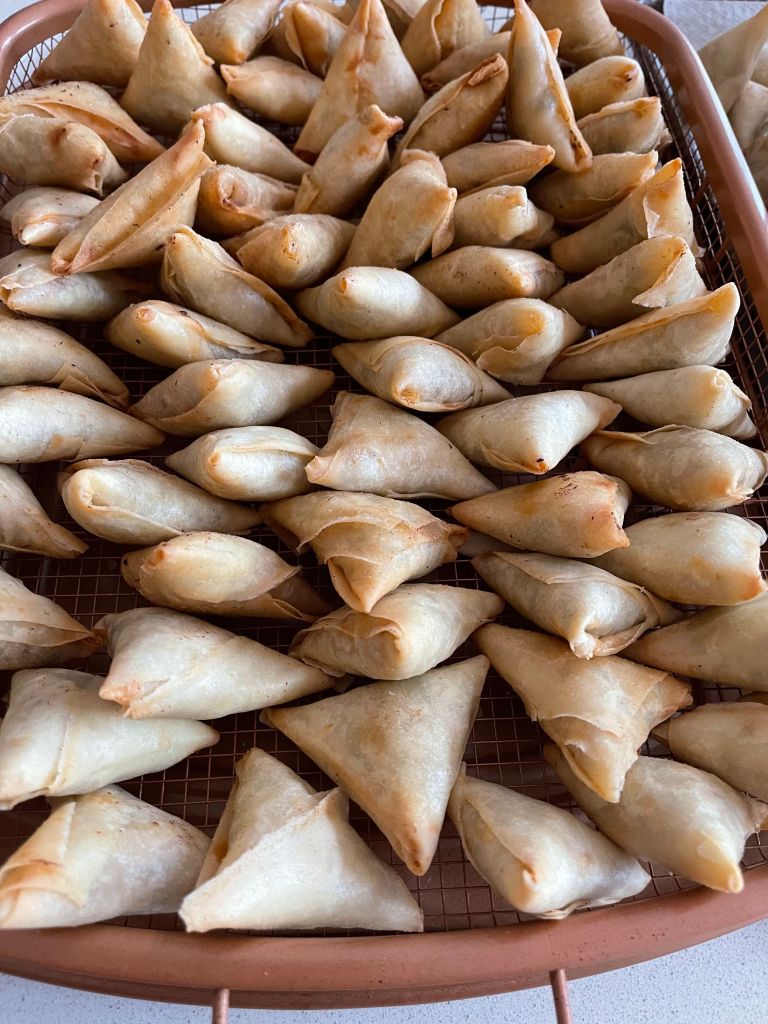
I usually flash fry the samosas on medium heat in oil once they are folded. Then once they are cool, layer them between parchment paper and freeze them in airtight containers. These come in handy when you want a quick snack or have unexpected guests, I just pull them out from the freezer and air-fry them for 8 minutes at 395°. No oil is needed as they are already half fried! they turn a beautiful golden that you get from deep frying.
I use an Instant Vortex Plus 6qt Air Fryer which fits in about 14 large samosas. Time and temperatures will vary with different Air Fryers.
Recipe Notes and Substitutes :
Finely chopped onions: I find them weep a bit more as they sit in the meat mixture, I find these cause the samosa pastry to soften and become soggy, and also release moisture into the oil whilst frying. I typically add chopped onions to a mince mixture that I going to use to make cutlets or bateta champ~ something combined with potatoes so that moisture gets absorbed. For samosas I usually use about 10-15 bunches of spring onions, I sauté a handful of the sliced whites part before adding the meat, and then add the rest of the white parts along with the greens later on. My family loves this version better.
Flour: to make the authentic traditionally homemade samosa ni rotli/ chappdi/patti or pastry you will need plain all-purpose flour, water, and salt.
Spring roll sheets: I use the Spring Home TYJ Spring Roll Pastry which are readily available from my local Asian supermarket, they come frozen, in two sizes, medium which will give you bite sized 1 1/2 inch samosas, and the large which yields about a 2 inch samosa. The sheets have to be defrosted and at room temperature, before you can cut the large squares into long rectangular strips. I measure out three sets of rectangles before cutting them up. I also find using two sheets makes a sturdier samosa than a single sheet which absorbs more oil. These pastry sheets work better for deep frying, they stay crisp and crunchy for hours and also freeze well.
Fresh chopped cilantro is key for beef or chicken mince (but if you don’t like cilantro just leave it out), mint pairs best with lamb meat.
Making Traditional Patti/Chapri/Chapdi/Wrapper (Stove-top or Oven Method)
Ingredients:
- 3 cups all-purpose flour
- 1 + 1/2 teaspoon salt
- 1 + 1/2 teaspoons olive oil
- 1 teaspoon lemon juice
- 1 cup or little more of water
- Extra olive oil to brush on the discs
- Extra all-purpose flour to sprinkle on the discs
Method:
- Knead the flour, salt, lemon juice, and oil using about ½ cup of tap water at a time till a soft dough is formed. Leave the dough covered aside for 15 minutes.
- Divide dough into 24 equal portions.
- Take 2 dough balls, dust in all-purpose flour and roll into about 4-inch circles.
- On one circle, brush a little oil all over the surface and then sprinkle all-purpose flour.
- Cover the oiled and floured circle with the other circle.
- Similarly, form the rest of the pairs of circles 12 circles (of two oiled circles).
- Then further divide the 12 into 2 stacks of 6 circles- oiling and flouring each dry surface except the top most layer.
- Roll each stack it out into a round of you are going to cook them on a pan on the stove top or oval shape if you are going to bake it in the over- either way the shape should be about 12 inches long.
To bake in the oven:
Heat the oven to 375° F. Transfer the oval stack onto a large baking tray lined with parchment paper, bake until you see a bubble rise up it should take about 5-6 minutes at the most- remove immediately, as we don’t want to bake this like a pita. Gently pull part the sheets, if needed put it back into the oven for a few seconds, and repeat until all sheets are separated.
To cook on stovetop:
Warm a large flat frying pan or tawa on medium heat, transfer the circle onto the pan, and cook one side for 3-4 seconds or you see bubbles appearing, flip it over and immediately peel off the cooked side while the underside is cooking, then flip the cooked side and peel the sheet while the and keep going until you have separated all the sheets.
- Stack all separated sheets together and using a sharp knife or kitchen scissors, trim off the edges to get a long rectangle or a 8×8 or 10×10 square.
- Then mark and divide the rectangle or square into cut into 3 strips as show in pic.
- Cover or wrap them up until ready to use.
Tried this recipe? Tag @spicymemsahib or #nadiasmeza to let me know – I would LOVE to see your creations!

 Nadia's Meza recipes
Leave a comment