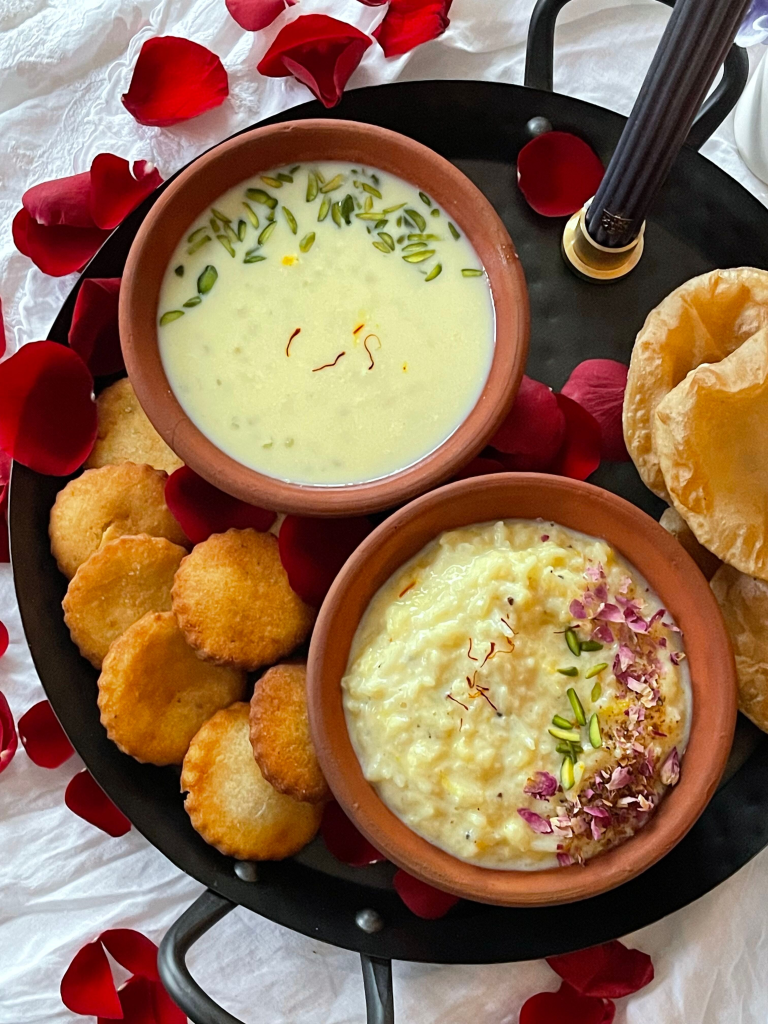
This bowl of kheer is loaded with legends, rituals, traditions and history. Terracotta bowls give it that earthen feel, and all of a sudden, this cardamom and saffron perfumed kheer has a story to tell, a glimpse into traditions and culture, not to mention how ridiculously impressive it looks.
In my Gujarati household, Kheer Puri was a staple dessert at every festival and celebration, if the aunty was coming from England, or if the aunty is going back to their “sasra” (in-laws) or you could just wake up one morning and there was Kheer Puri again, just because.
Kheer was always served with puffy white puri’s that you would tear using your thumb and first and second fingers together, breaking off bite sized pieces to scoop up the kheer. The kheer my grannies and mum made was thick and creamy, full of plump golden raisins, slowly simmered and stirred over a stove, it was a labor of love and patience.
Think of it as a dance of milk and rice, like dervishes dancing around and round the pan swirling and twirling for a couple of hours. Midway grannie would add saffron and hand ground cardamom. The saffron pistils add its distinct Kesri color and the cardamom perfumes the kheer with its heady aromatic fragrance.
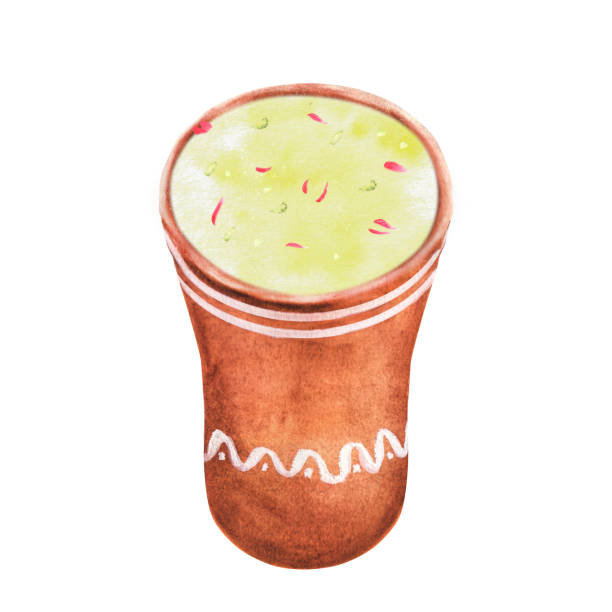
In my great-granny’s time, before refrigerators they would serve the kheer in wet clay pots which kept the kheer chilled.
My version of the Instant Pot Kheer takes 20 minutes, because let’s be honest, who has time to stir kheer for 2 hours today?
What is Niaz or Nazr?
Nazr (vow) means making it obligatory upon oneself to do some good act, or to refrain from doing an act which is better not to do
When I got married, Kheer & Puri was only cooked during the Islamic month of Rajab, and served as Niaz /an offering. Culturally and regionally the Niaz differ, in Tanzania, for example the Niaz would take place at the mosque, everyone would gather around with their bowls of kheer and puri, fishing for hidden silver rings, and enjoy the Fathia. There was strong and saccharine social binding, holding the community together as a family. There was no distinction made between rich and poor, everyone was invited.
In the US, you would be invited to multiple “koonday”, almost like an open house if you will. You arrive at a decent time, and once you are done eating the niaz famous for its special crispy meethi tikiya (fried sweet bread) and kheer, the proper etiquette is to leave as more guests arrive, and of course, you have more houses to visit, and more kheer to taste.
‘The Koonday’ of the 22nd of Rajab in the Islamic calendar is dedicated to 6th Imam Jafar-e-Sadiq. Shia Muslims will celebrate the day with spiritual offerings and organize a social gathering with friends and family. Symbolically, the nazar /offering is done on meethi tikiya (fried sweet bread) and kheer/rice pudding which is kept in a koonda /clay pot. This is one such tradition that is widely practiced in my US community.
And a sweet Sunday School Mum, Afreen shared her recipe with me for the Meethi Tikkiya. Over the years I have modified it to what works for me, less semolina and more flour to get that almost fried cookie /sakarpara texture.
I have blended our two cultures together, and our blended culture is our identity. It has become who we are. Each home has that one dish that’s famous in their family, whose recipe gets passed down and around so that everyone can always enjoy it.
Here is the puri, Gujarati Kheer, Sabudana Kheer and the Kheer with Mithi Tikkya recipes.
Ingredients:
- 3 cups Whole full fat Milk/ I also use Oatly Full Fat milk {vegan version}
- 1/2 cup water
- 1/2 cup evaporated milk (optional)
- 1/2 cup white basmati rice
- 1/2 cup sugar or to taste
- 1/4 cup roasted nuts chopped or sliced almonds & pistachios
- 1 tablespoon golden raisins (optional)
- 1 teaspoon cardamom powder
- pinch of saffron (Kesar)
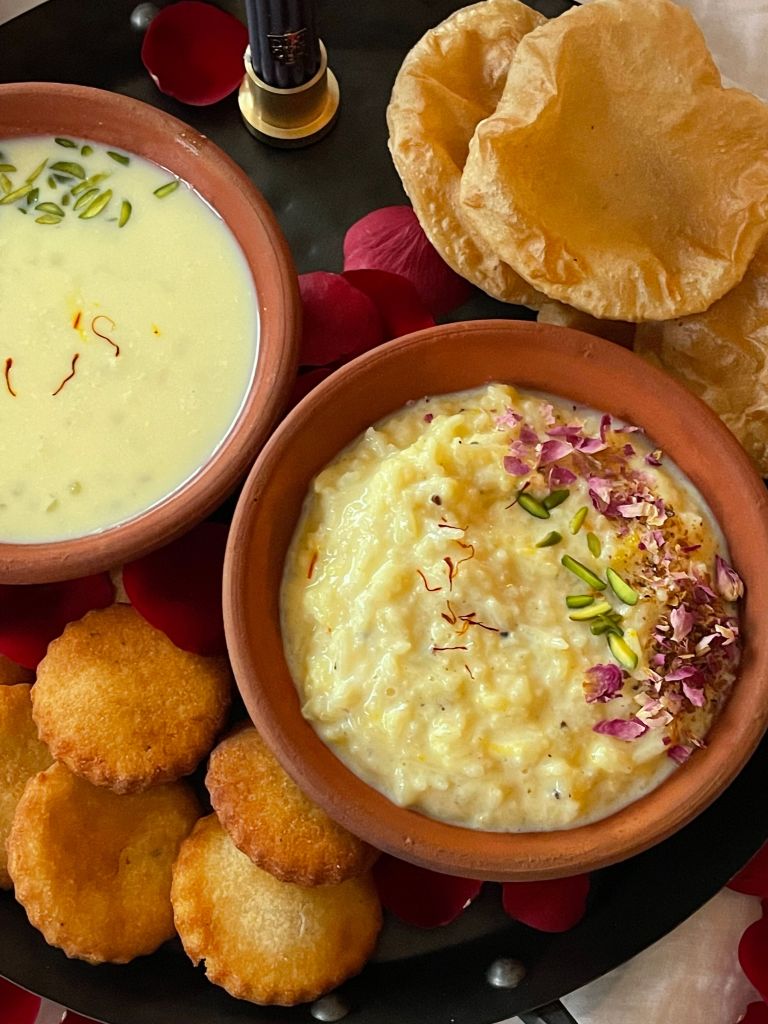
Rice Kheer/Rice Pudding
Instructions:
1. Boil 1/2 cup water in the instant pot on sauté mode this will help prevent the milk from burning.
2. Add all the ingredients in the instant pot steel insert and half the nuts. Close lid with vent in sealing position.
3. Set the instant pot to PORRIDGE mode for 20 minutes on high pressure, or pressure cook for 20 minutes on high pressure.
4. Let the pressure release naturally.
5. Meanwhile sauté the almonds in a tablespoon of oil until a light golden brown and remove with a slotted spoon and keep aside.
6. Open Instant Pot and mix well.
7. If needed, to get the desired consistency, cook in SAUTÉ mode for 2-3 mins. Or if too thick, add more milk, mix and let it cook for a minute.
8. Serve hot, warm, cold or at room temperature. Topped with remaining nuts.
This was made in a 6qt Instant Pot DUO60. I have an extra sealing ring for sweet foods, and yoghurt so everything doesn’t smell of onion garlic!
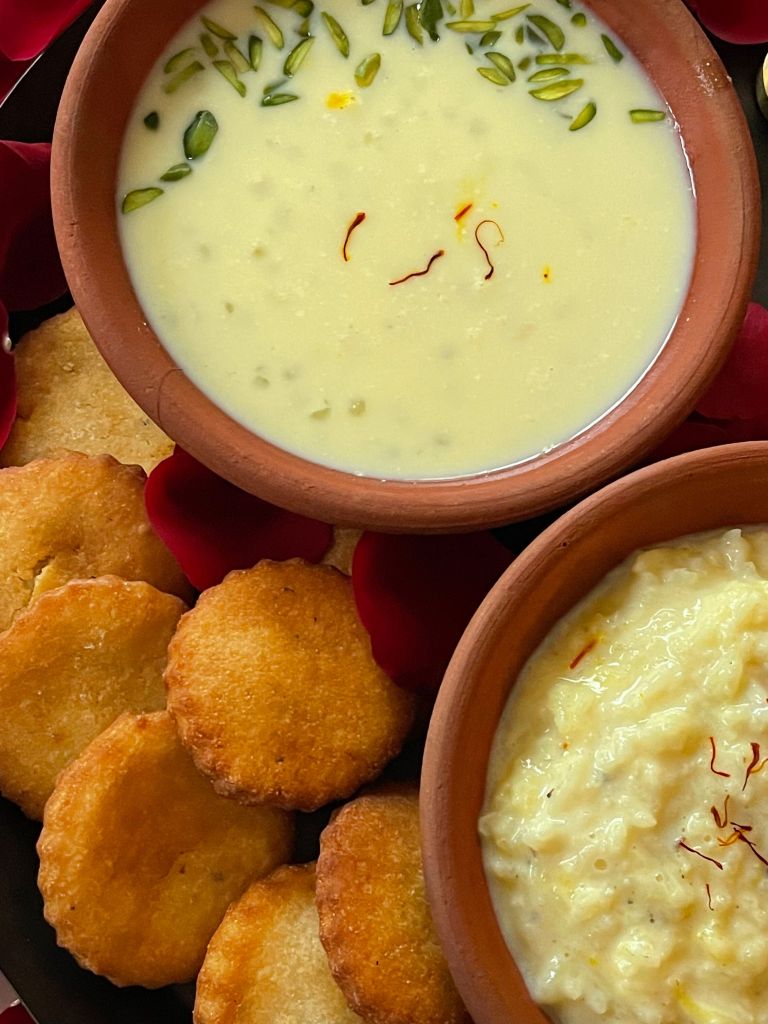
Sabudana Kheer/Tapioca Pudding/Sago Pudding
- Wash the tapioca pearls, then cover with water and soak for 6 hrs or overnight.
- Use the same method as for rice kheer
- * for vegan version- since vegan milk curdles when heated, cook the sago/sabudana in water until they soften, then add the Oat, almond or coconut milk and heat on low heat until the milk starts to just boil.
- I love using Charoli commonly known as chironji seeds or almondettes, along with a combination of fruit and nuts. I use various combinations of walnuts, pecans, cashew nuts, sliced pistachios, sliced almonds, figs, dates and golden raisins.
- You can also flavor the kheer with some rose water, kewra (screw pine water), orange blossom water, or vanilla extract or cinnamon powder.
Puri
- 2 cups *Sharbati whole wheat flour
- 2 teaspoons oil
- 2 tablespoons fine sooji / fine semolina ( optional) or use 2 Tbsp. of plain flour instead
- 1.5 teaspoons Pink Himalayan salt
- Approx. 1 cup warm water
- neutral Oil for deep frying
Instructions:
1. I bind my dough in my KitchenAid mixer- In the bowl mix whole-wheat flour, souji, and salt. Add water as needed to make firm but smooth dough.
2. Cover dough and set it aside for 15 minutes or longer.
3. Divide the dough in equal parts and mine were 25gms each.
4. Roll the dough into balls between your palms.
5. On a clean work surface or using a wooden rolling board, roll the dough into about 3-inch diameter.
6. If the dough sticks to the rolling pin or rolling surface, grease the surface and rolling pin with some oil.
7. You can roll all the puris out at once but make sure you cover them with a kitchen towel to prevent them from drying out, ideally, you should roll 4-5 and fry, and then repeat even better if you have someone to help you, one person can roll whilst the other fry.
8. Heat about 1- 2 inch of oil in wok or karai on medium high heat to 200°C/400°F. * see notes
9. Place the puri in the karai and press it ever so gently with a skimmer, puri should puff right away.
10. Turn puri over, it should be light creamy light beige -brown from both sides.
11. Take the puri out and place it on paper towels to absorb the excess oil.
Meethi Tikkiya/ Fried Sweet Bread
- 1 cup Plain flour
- ½ cup Sooji/ fine semolina
- 3/4 cup or a bit less of white sugar
- 1/2 cup desiccated coconut or coconut powder
- ¼ teaspoon / small pinch of baking powder
- 1/2 cup of evaporated milk + 1 tbsp. heavy whipping cream
- 1 teaspoon oil
- 1 generous pinch saffron pistils
- 2 tablespoons white sesame seeds
- 1 teaspoon coarsely ground cardamom powder
- Neutral Oil for deep frying
Instructions
- Combine all the ingredients except the evaporated milk in a large bowl.
- Knead adding the milk a little at a time, just until it all comes together to form a cohesive ball – it should hold together and if it is a little hard then add a wet your hands with water and knead and if it’s too sticky then coat your palms with flour and knead to bring to together. Don’t add flour and milk by the spoonful randomly.
- Set the dough aside and let it rest for at least 3 hours or more.
- Heat oil on a low flame in a wide pan/wok/karai. Pinch of a small piece of dough and flatten it, then drop it into the oil, it should sink to the bottom, then gradually rise up, that means the oil is ready, if it darkens and burns then the oil is too hot, and you need to add more oil to bring the temperature down.
- Roll out the dough on a lightly floured surface and roll out to about ⅛ of an inch or sugar cookie thickness.
- The tikkis will puff up a little when cooked.
- Use a 1 ½ to 2 inch cutter to press out the discs/tikki.
- Fry one to test, cook till lightly golden for about 2-3 mins.
Watch me make it here:

 Nadia's Meza recipes
Leave a comment