
If you’re looking for an easy, summer-friendly meal, look no further than curd rice. This humble dish is one of the quintessential comfort foods of South India, cherished as if it were a feast fit for a king.
I know you must be thinking, a cold rice and yogurt, really? but for those of us who grew up with it, it holds a special place in our hearts.
For South Asians, “curd” (or “desi dahi”) typically refers to unsweetened yogurt. Across northern and western India, curd rice is known as dahi chawal or dahi bhaat. In the five Southern states, this beloved dish has many names. In Andhra Pradesh and Telangana, it’s called daddojanam or perugu annam; in Tamil Nadu, thayir sadam; in Karnataka, mosaruanna or bagala bath. But no matter what you call it, curd rice is the go-to dish when you want something easy, refreshing, and nutritious.
Why Curd Rice Is More Than Basic
This dish may seem basic, but it’s steeped in tradition and love. It’s the kind of meal that nourishes not just your body, but your soul. Whether you enjoy it plain or dressed up with fancy garnishes, and sides of pickles and papads or far fars, curd rice is a reminder that the best things in life are often the simplest.
So, the next time you’re craving comfort or looking for something light and refreshing during the summer months, give curd rice a try. You just might find yourself falling in love with this cherished South Indian staple, just like I did.
What Exactly Is Curd Rice?
One of the best things about curd rice is that it can be made with either freshly cooked rice or leftovers. In fact, if you’ve got some rice sitting in the fridge, you can whip this up in about 10 minutes!
The Simple Process
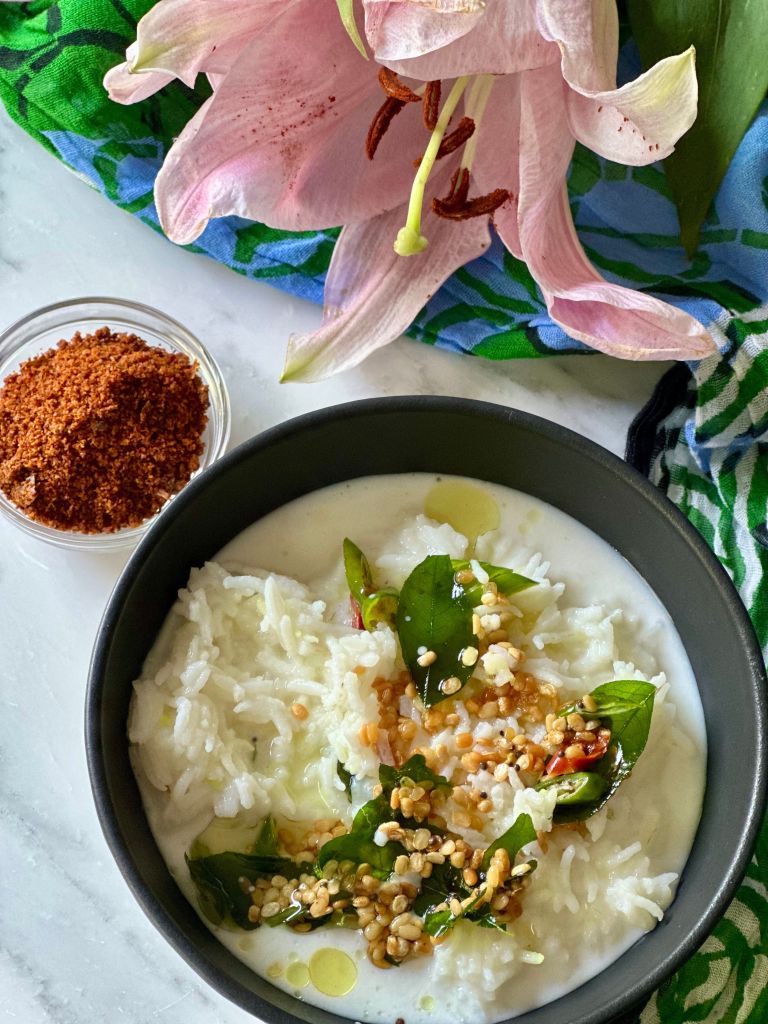
Start with rice cooled to room temperature. Mash it by hand with a wooden spoon or a potato masher, and mix it with yogurt. You can add a splash of milk to cut the sharpness of the yogurt, although I do not. Now comes the only part where you will have to pull out the pan and turn on the stove for 3 minutes to make a tempering or tadka that will infuse the dish with warmth and flavor. Mustard seeds, curry leaves, dried red chilies, husked urad dal, a little chopped ginger, and green chilies all bloomed in oil or ghee.
Mix the tempering into the rice, and voilà—you have a dish that tastes like home. Serve it with a side of podi or gunpowder like I did, or a hot mango pickle, some papad- absolutely heavenly. Did you know that this dish has deep cultural roots? and is often made as a prasad during festivals like Dassahra? It’s not just food; it’s an offering, a blessing, and a reminder of how the simplest ingredients can create such a soothing and suspiciously fast company-worthy meal.
During South Indian celebrations, you’ll sometimes see curd rice garnished with vibrant pomegranate arils or fried nuts, adding a colorful, festive touch.
My love for all things South Indian
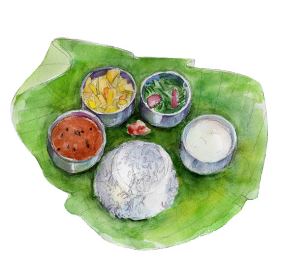
When I was younger and complained of an upset stomach, or was just recovering from an illness plain warm rice with yogurt was hailed as the solution for most ills. Dishes like dahi waro vagarelo bhaat, kichdi-chaas, kanki, or any type of rice with yogurt have always been my comfort meals. But I truly fell in love with curd rice during my school years in Bombay. When my dad would come to visit, we’d head to the South Indian buffet at Udupi Palace. Curd rice was always served on a banana leaf, with a pickle on the side, and it quickly became my favorite part of the meal. My Dad would sometimes be baffled why I would choose to eat this simple dish over and over again when there was an entire buffet to choose from.
I like mine slightly runny, salty, with a refreshing bite from the cilantro, paired with a hot mango pickle or some podi and a papad.
Ingredients
- 2 cups cooked rice ( basmati or jasmine)
- 1 cup plain yogurt (I like Greek yoghurt)
- 3/4 cup water ( I don’t use milk but you can)
- 2 tablespoons oil or ghee
- 1 teaspoon mustard seeds
- 1 tablespoon split skinless urad dal /black gram
- 3 hot Thai green chilies sliced
- 6-8 curry leaves
- ¼ cup cilantro
- 2 dry red chilies
- Salt to taste
- 2 tablespoons whole cashews ( fry these in the oil for a few minutes and keep aside for garnish)
- 1 tablespoon chopped cilantro
** you can add vegetables like grated carrots or steamed and grated beetroot.
Prepare the Cooked Rice
- Have the rice cooled and ready in a mixing bowl.
- Use a wooden spoon or potato masher to mash it. If you are using leftover rice, splash a bit water over the rice and microwave it until it is warmed through then mash it.
- Add yogurt, water and salt to the bowl and whisk, don’t worry if it looks mushed, its is supposed to be.
- If you are adding extra veggies, like carrots or beetroot- add it at this point.
This is a classic Indian cooking technique of heating oil, adding dry spices, garlic, ginger and herbs like curry leaves and cilantro to infuse the oil.
Heat the oil – reduce the heat to medium, add mustard seeds and when they splatter, add the urad dal, once the dal turns a soft pale pink, add the the grated, ginger (if using) green chilies, and curry leaves in that order
Turnoff the heat and let the pan sit to crisp up the curry leaves.
Mix half of the tempering into the rice mixture and mix it well, reserve some of the the tadka for garnish.
Garnish with chopped cilantro and a spoonful of the tadka, top off with and pomegranate arils and fried cashews.
- If you want to elevate the dish, you can add these extras.
- Garnish with Pomegranate arils or fried cashews
- Vegetables – Add cubed multi colored bell peppers, or grated steamed or cooked beetroot for a gorgeous pink hue.
Watch me make it here:
Notes:
- I have used leftover rice here, I warmed it up before mashing it. However, freshly made rice is recommended.
- I did not use ginger here, but you can, This rice is usually made with grated ginger.
- You can use homemade, store-bought plain yogurt or Greek yoghurt to make this. If the yoghurt is sour, adding milk instead of water will level out the tartness.
- Never mix yogurt with hot rice, it will curdle.
Did you make this recipe?
Tag @spicymemsahib on Instagram

 Nadia's Meza recipes
Leave a comment