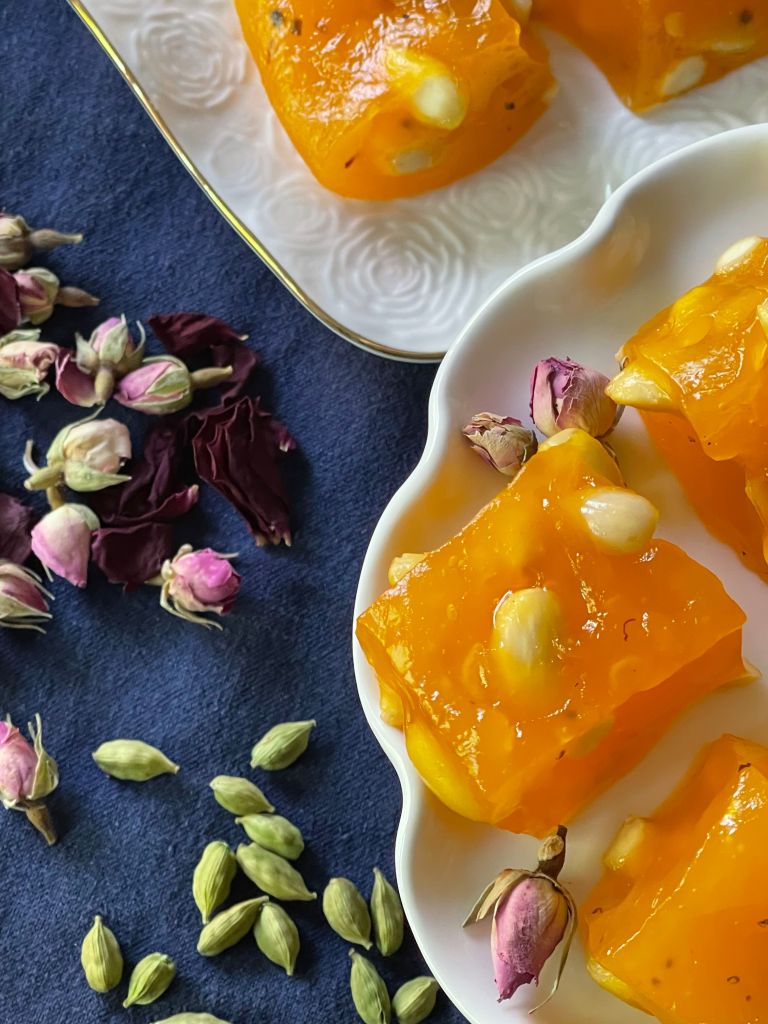

Meet the Queen of African Halwas-she is scented in Rosewater and Cardamom and the color of an African sunrise!
This Halwa can be traced back to the Omani empire’s ties with Zanzibar as far back as the 18th -19th centuries. With the arrival of Arab traders and settlers along the East African Coast, their rule stretched from Muscat to Zanzibar, bringing with them habits, customs, culture, and gastronomy.
Arab sailors would carry halwa, probably their version of an energy bar, for long Indian Ocean crossings into Tanzania and Kenya, preserved in palm leaf. The Arabic word “helw” literally means sweet.
I think the addition of cardamom to the halwas came during these settlements, for surely, the world’s second most expensive spice would not be spent on mere sailors.
The two most common ones you will see are the orange or brown halwas, some have whole almonds, or cashews, some have sesame seeds, locally known as-Malindi, Mombasa, Zanzibari, Omani or Bharaini Halwa.
This is really my first love in mithais; if you are from the Arusha/Moshi region you will probably remember this being sold in little white boxes with clear windows by the Bohora uncle who used to make the Orange & Almond and Brown Cashew Halwa.
I remember my Sunday walks with Grandad/Uncles/Dad to Somji Pan House, or Astab, or to the tuck shop outside the Metropole cinema, these were my weekly treats.
Growing up in England I could not find these, and I would peel the chocolate off the Turkish Delights just to get to the rose scented jelly like Halwa. Mum would bring a bagful’s of these when she visited, saying, “as soon as I got my visas, I placed an order with the Bohora uncle for these” or “I have guarded these with my life from those customs people”.
My last trip home, I scoured the streets of Arusha/Moshi, Dar to Zanzibar yet couldn’t find the white boxes, and the Bohora uncle and his operation were nowhere to be found. What I did find was the brown Omani Halwa served in large sinias/trays or commonly wrapped in waxed brown paper sheets or small woven straw or palm leaf baskets called Kitalifa.
That is when I came back to my Mum’s recipe, it is so, so close to the Bohora uncles, one piece of this wiggly halwa, and I promise you the colors, the scents, and the sunrise of Africa!
Ingredients:
- 1 cup Tapioca Starch or Cornstarch
- 2 and 1/4 cup white sugar
- 2 cups water
- 1.5 cups or 8 tablespoons butter (1 US stick) or ghee (I used butter)
- 1.5 teaspoons coarsely crushed cardamom seeds
- 1 cup skinless whole almonds or 2 cups almond slivers
- 1/2 teaspoon orange food coloring (McCormick Nature’s Inspiration Food Colors)
- 1/2 teaspoon lemon juice
- 2 -3 tablespoon Rose Water (Not essence!)(I used 4 tablespoons)
Microwave Method
- In a large microwave safe bowl, mix the flour, water, food coloring, to form a lump free paste
- Add almonds and butter
- Microwave for 5 minutes on high
- Remove from the microwave and stir vigorously, add cardamom powder and put it back in the microwave for another 5 minutes.
- Keep doing this in 5 minutes intervals 6 times for a total of 30 minutes.
- On the 5th cycle, add lemon juice and rose water
- After the final cycle, pour into a baking dish and let it cool.
- Garnish with sliced almonds if you like.
Stovetop Method:
- In a bowl, mix the flour, and 1 cup of cold water, and food coloring to form a lump free slurry/paste.
- In a saucepan melt the butter/ghee, add cardamom powder then set aside.
- In a deep non-stick pan, mix the sugar and the remaining 1-cup of water.
- Place it on high heat and bring to a boil so that the sugar dissolves.
- Pour in the flour slurry and stir constantly for about 10-15 minutes.
- Add almonds, rose water and lemon juice
- Keep stirring on high heat until the mixture starts to thicken then lower the heat
- Add the melted butter /ghee a tablespoon at a time, all the while keep stirring, to incorporate it all into the mixture
- Increase the heat slightly and keep stirring until a ball forms and slides around the pan -should take about 30-35 minutes.
- Pour into a baking tray and let it cool then cut into squares
- Serve with strong black coffee or with a piping hot cup of English tea

Notes from my kitchen:
- White sugar gives you the burnt orange colored halwa, and if you use brown sugar you will get the amber colored halwa.
How To Blanch Almonds - Measure out the almonds you want to blanch
- Boiling water on them and leave them for 5-10 minutes
- Drain the almonds and rinse them with cold water to cool them down.
- Squeeze each almond to remove its skin.


 Nadia's Meza recipes
Leave a comment