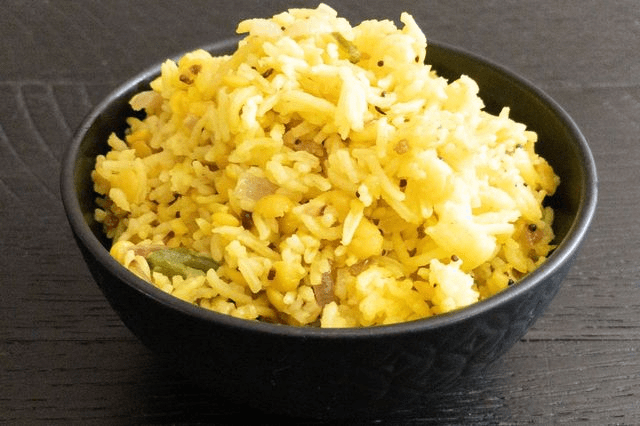
While the real Sunday bake is in the oven, tucking into Toovar ni Dar ni Kichdi, kobich batata nu shaak and vaghareli chaas. This simple Sunday meal of rice and lentils, has deep rooted in the history for anyone from the Indian subcontinent.
Often known as a peasant food of rural India each region of India has its own version of khichdi. In my Gujarati family it was a Sunday meal, always made with rice, split pigeon pea dal, turmeric, salt and served with a dallop of ghee, a dry shaak, or a tomato based shaak, in the cooler months with spicy steamy hot Kadhi, and during the hot African summers with a cooling vaghareli chaas/ spicy lassi, and rice flour papdi.
Pigeon Peas/tuver, ni dal along is one of those heirloom dals most used in Gujarati kitchens.
My first memories of food goes back to harvest season and grains and lentils prepared for the coming months. Unlike the times we live in, the luxury of lentils or rice did not come in packets you purchased from the local store, that you just opened up and filled in fancy glass container with wooden lids and stuck a glossy label “Toor Dal” so that any stranger in your kitchen could identify the lentils.
When I was younger, the lentils, grains, and rice once harvested, dried oiled, and milled were either stored in stainless steel containers that would break a nail or two if you tried to pry it open, or large plastic drums with equally stubborn lids.
There there was fervent picking for stones and bad or rotten grains as they came in from the farms in gunny sacks, followed by a frenzy of washing the lentils all so that the grains would have enough time to dry in the blazing hot sun. Each lentil had multiple uses, some were stores whole, some were split in half using the huge stone hand-mills that grannies would churn round and round, then those would be sieved to separate the broken grains from the perfectly split ones. The broken batch was then bagged up and the house help was dispatched to to the neighborhood flour-mill for milling. This was the long and laborious process for every single legume and lentil or rice. clean-wash-dry-clean-store.
Some got a good oiling to preserve them for the coming year and prevent bugs, others got an extra dose of sun, and as the milled flour comes back, some gets mixed with other lentils to create different flours, others get turned into vadi’s/farfar or faryum’s, from the kitchen to the outer verandas saris laid out as homemade papdi and papads dry under the glare of the hot summer sun,
The reasons for this sequence remain wrapped in culinary traditions, but an integral and intriguing part of our food culture.
This delicious meal is gluten free and by switching to a plant based ghee- make it vegan
Ingredients:
- Ratio of rice to dal 1: .5
- 1 cup basmati rice
- 1/2 cup tuvar dal (split pigeon pea lentils- oiled)
- 5 cups water or more as needed
- 1 teaspoon sea or Himalayan salt
- ½ teaspoon turmeric powder (haldi)
- 1 tablespoon ghee
Instructions:
- Wash the Tuvar dal to remove the oil and soak it for 30 minutes
- Before cooking the Kichdi, wash and soak the rice for 10-15 minutes
- Bring large pot, filled with 3 cups of water to a rolling boil
- Add the Tuvar dar, salt and turmeric and cook on medium to high heat for 8-10 minutes, until partially cooked (test to see if its cooked by fishing out a some lentils and pressing between your forefinger and thumb, it should be al dente cooked and still a little hard in the middle.
- Dal’s cook differently everywhere, for example, quality of the lentils, hardness/softness of water, whether the dal was soaked or not play an important part in the cooking process. Soaked dals take a little less time (for example back home in Tanzania, dal would take about 20-25 minutes to get to a tender stage, whereas in the US it takes 7-8 minutes)
- Add about another 2 cups of water, and let it come to a quick boil and add the rice, and cook for 8 minutes, uncovered over a medium heat, stirring occasionally until rice is cooked about 85%.
- Take a strainer and drain the rice and dal, just like you would so if you were cooking pasta.
- Return it to the pan, pour a tablespoon of ghee and cover with a lid, lower the heat and let it steam cook for another 6-8 minutes before turning off the heat.
Serve with ringan bateta nu shaak/kobich bateta nu shaak, Koru bateta nu shaak, yoghurt, vaghareli chaas, papdi and mango pickle.
Got Leftovers?
Bonus recipe:
- Use the leftover kichdi the next day and turn it into a quick snack, tastes even better with thicka parathas and chai.
- Heat 2-3 tablespoons of oil in a wok/ Karai
- Add 1/2 teaspoon mustard seeds and when they pop
- Add 1/2 a finely chopped onion and chopped green Jalapeños or Thai hot peppers
- stir for a few minutes and add about 2 or 3 cups or more of the left over kichdi (adjust oil and onions according to how much leftover kichdi you have)
- Stir fry the rice in the tempering for a a few minutes, and serve hot!
Notes:
Cook the rice and toor dal separately – as opposed to dumping everything in a pressure cooker – because they need different cooking times.
Oily or not OilyTuvar/Toor Dal ?
As a rule of thumb I only purchase the oily style of split pigeon peas (toor/tuver/arhar). Just my grannies and Mum did, these are picked of any stones, dried and coated in oil to preserve them for months. I think the taste is different as well from the unoiled dals.

 Nadia's Meza recipes
Leave a comment